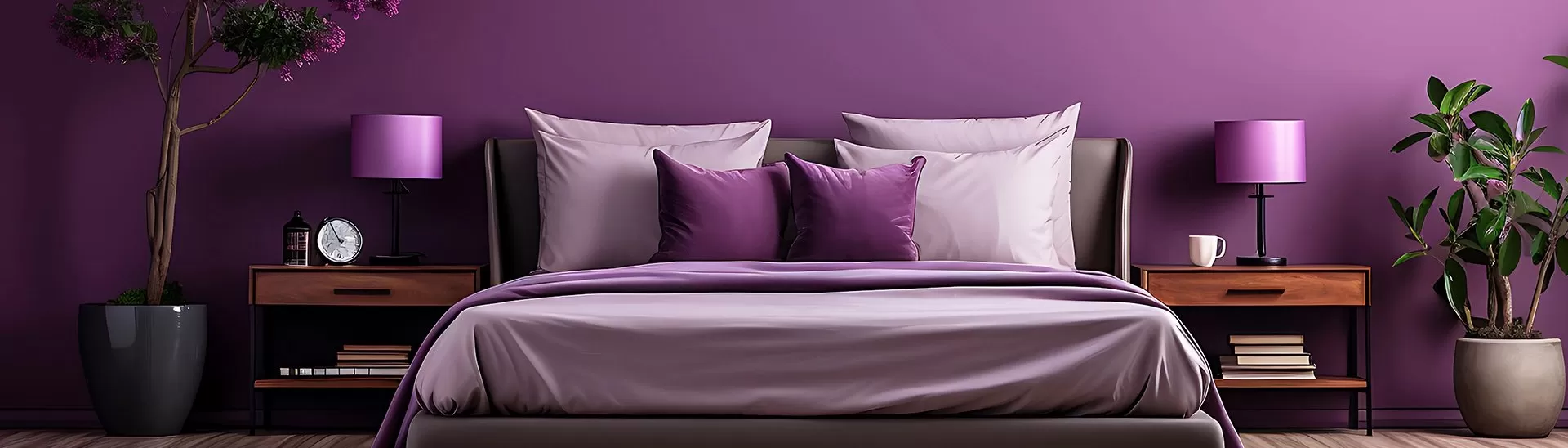
Here’s the honest truth to begin with: most people don't plan for purple. It tends to find them - in a paint swatch they almost passed over, in a friend's apartment that stayed in their head for weeks, in a sunset they wanted to somehow bring indoors. Purple falls in that rare space between bold and calm, and rooms painted in the right shade of it have a quality that's genuinely difficult to replicate with any other colour.
Red and blue come together to make purple, and it’s mostly chosen for feature walls. But, there’s certainly more to this shade. Spend an afternoon in a room with well-chosen purple walls, and that logic falls apart completely. Whether it's a dusty lavender catching afternoon light in a bedroom or a deep plum anchoring a living room walls, purple earns its place.
This guide aims to cover all of it, from how to mix purple from scratch to which ready-made shades work best for different kinds of rooms. Get started!
Purple Colour Composition
Purple is a secondary colour, appearing between red and blue on the colour wheel. Red colour carries the warmth and intensity; blue brings in the calm and coolness. The resulting purple depends entirely on how much of each parent colour you bring in.
What Colours Make Purple?
● Purple is obtained by mixing the primary colours red and blue.
● Purple holds two emotional registers at once: energising and soothing, bold and restrained.
● Tip the balance toward red, and it feels passionate, almost theatrical.
● Tip it toward blue, and it turns contemplative, almost meditative. That is exactly why it works so well in interior walls.
How to Make Purple Colour
The mechanics are simple; the care is in the details.
- Start with a clean tray or mixing surface - Even a small trace of another colour will affect your result, especially with something as tonally sensitive as purple.
- Choose your red and blue carefully - Crimson red paired with ultramarine blue gives a cleaner, truer purple; scarlet red with cobalt pulls it warmer and more violet.
- Mix equal parts to begin - This gives you a neutral colour base purple to work from.
- Adjust the ratio slowly - Add more blue colour for a cooler purple colour shade, more red for something warmer and richer.
That's how you make purple colour at its most essential. Everything else (depth, warmth, lightness) comes down to what you add from here.
What Two Colours Make Purple Colour?
Different red and blue combinations produce noticeably different purples. Here's how some common pairings perform:
|
Complementary Pair
|
Tone Produced
|
|
Crimson Red + Ultramarine Blue
|
True, balanced purple
|
|
Scarlet Red + Cobalt Blue
|
Warm, reddish-violet
|
|
Magenta + Prussian Blue
|
Deep, jewel-toned purple
|
The cooler and more neutral your blue, the cleaner your purple reads. The warmer your red, the more it tips toward wine or berry.
Also Read: 5 Beautiful Shades of Purple to Elevate Your Home Interiors
How to Make Purple Colour by Mixing Two Colours
Ratios are what define the outcomes. Small shifts produce surprisingly different results:
|
Ratio (Red: Blue)
|
Dominant Colour
|
Result
|
|
50:50
|
Equal parts
|
True, balanced purple
|
|
60:40
|
More red
|
Warm, reddish-violet tone
|
|
40:60
|
More blue
|
Cool, blue-leaning purple
|
|
70:30
|
Heavy red
|
Deep wine or magenta-purple
|
|
30:70
|
Heavy blue
|
Periwinkle or denim purple
|
How to Make Light Purple Colour
Soft purples come from folding white into your base purple mix. The process needs patience. Add white colour in small amounts, mix it completely, then assess before adding more. Going too fast produces a chalky, washed-out tone rather than a genuinely airy one. A well-made light purple should still appear as purple.
How to Make Dark Purple Colour
For dark purple, add black or dark navy blue to your base - not both at once, and never in large amounts. Black, in particular, is aggressive; it flattens colour quickly and reduces the vibrancy of purple before you realise what's happened.
Some dark purple colour shades worth aiming for:
● Purple Shade - Carries a vintage richness that works beautifully with gold and wood tones
● Purple Gaga - Almost appears dark neutral in some lights; endlessly sophisticated
● Mystic Purple - Best used on a single focal wall
● Purple Shade - A gemstone-quality depth with an almost luminous quality under the right lighting
How to Adjust Purple Colour Tone
Once you have a base purple shade, you can steer the tone in three directions - and each produces a genuinely different feeling on the wall.
● Warm purple - A small addition of red, or an even tinier touch of yellow-orange, pushes purple toward mauve colour, berry, and reddish-violet shades.
● Cool purple - Add a bit more blue or a trace of grey colour. The result is more restrained - quietly confident rather than expressive.
● Muted purple - Add a small amount of yellow colour, which is purple's direct complementary colour. This dials down the saturation and creates something dustier and more complex.
Also Read: Purple Two Colour Combination for Bedroom Walls
Popular Purple Shades in Nerolac Paints Colour Catalogue
Nerolac's purple range runs across the full spectrum, from the barely-there light purple shades to the darker hues.
Brinjal Purple
Dark, aubergine-deep, and authoritative. Brinjal Purple colour is the shade for a feature wall that needs to hold a room together without any support.
Mystic Purple
Mystic Purple colour is a mid-depth purple with something almost hazy about it. Not mysterious in a theatrical way - just quietly compelling.
Purple Aster
Named after the wildflower, there's a natural warmth in this shade that feels organic rather than designed. Purple Aster colour is one of the more versatile everyday purples in the range.
Purple Gaga
It’s a statement colour that does not attempt subtlety. Purple Gaga colour is suitable for rooms where you want the wall to be the statement.
Purple Pashmina
Purple Pashmina colour name earns itself. Soft, warm, and textural in feeling - this is a bedroom purple if there ever was one.
Purple Saga
Cool-toned and composed. Purple Saga colour leans slightly blue and carries a dignified quality that suits formal spaces and hallways.
Purple Shade
Purple Shade colour is a balanced, mid-register purple that doesn't strongly commit to warm or cool. Reliable in the best sense - works across multiple room types.
Purple Tourmaline
Deep, gemstone-rich, and slightly luminous. Purple Tourmaline colour responds to lighting changes throughout the day in a way that makes it feel almost alive on the wall.
Ready-Made Purple Colour Options
Mixing purple yourself is worth doing when you want a custom tone. For wall coverage across a full room, though, ready-made shades have clear advantages:
● Batch consistency - Pre-mixed paints hold the same tone, litre after litre, which matters enormously when you're covering several walls
● Formulation accuracy - Each shade is balanced for a specific finish and surface performance, not just colour appearance
● Time efficiency - No test batches, no adjustments, no second-guessing ratios before a painting day
For those who want to skip straight to the application, these four Nerolac shades are strong starting points:
● Purple Aster
● Purple Gaga
● Purple Pashmina
● Purple Saga
Before purchasing, try Nerolac's Colour Visualiser tool. Upload a photo of your room and preview how each shade feels on your walls under your actual conditions.
Why Purple Colour Looks Different on Walls
You've chosen the shade carefully, tested it, felt confident - and then it goes on the wall and looks completely different. This is one of the most common frustrations with painting, and purple is more susceptible to it than most colours.
● Lighting - Natural daylight shows you the truest version of a purple. Warm incandescent bulbs pull it toward red and pink. Cool LEDs push it bluer and sometimes greyer.
● Surface texture - Textured or uneven walls create micro-shadows across the surface. These make the colour appear darker in recessed areas and lighter on raised ones.
● Paint finish - Matte finishes absorb light and make colours feel deeper and softer than they are. Satin and gloss finishes reflect light, making the exact same colour appear brighter and more saturated.
Common Mistakes to Avoid When Mixing Purple Colour
● Not measuring ratios - Eyeballing works for small art projects. For wall paint quantities, even a minor inconsistency between batches becomes visible over a large surface. Measure properly.
● Skipping the wall test - Testing on paper, card, or a mixing tray tells you very little about how a colour will actually look dried on your wall. Always test on the wall itself, let it dry fully, and assess it at different times of day before proceeding.
● Adding too much black - By far the most frequent problem with dark purple attempts. Black neutralises colour aggressively. One drop too many and you've got a muddy grey-purple that can't be recovered easily. Add it in the smallest possible increments.
Also Read: Modern Two Colour Combination Ideas for Living Room
Mixing Purple Colour for Wall Paint vs Wall Art
The goals are different, and the approach should be, too. For wall paint, consistency is everything. Slight variations between batches are noticeable across large areas, so mixing everything in one session and in measured quantities is non-negotiable.
For wall art or canvas work, batch variation is often an asset. Slight tonal differences between applications add depth and movement to a painted surface. You also have room to experiment with unusual additions - a touch of burnt sienna for warmth, a hint of pink colour for softness, a scrape of purple for an aged, earthy quality.
Where to Use Purple Colour
Purple works across almost every room in the house, as long as the shade and placement are matched thoughtfully. Here's a quick room-by-room guide to get you started:
|
Room
|
Best Purple Shade
|
Placement
|
|
Living Room
|
Purple Gaga, Brinjal Purple
|
Feature wall or full room
|
|
Bedroom
|
Purple Pashmina, Mystic Purple
|
All walls or accent wall
|
|
Kitchen
|
Purple Aster, Shush Purple
|
Single-wall or lower cabinets
|
|
Balcony
|
Purple Saga, Purple Tourmaline
|
Full wall or border trim
|
Purple Wall Colour Combinations for Your Home
● Purple and purple - One of the most underused pairings in interior design. Purple grounds purple's intensity and brings warmth to what can otherwise appear as a cool colour.
● Purple and Beige - This is the combination that makes purple accessible for people who aren't sure about committing to it fully. Beige colour keeps the room feeling open. Nearly any purple tone pairs with beige without clashing.
● Purple and Violet - A tonal layering approach rather than a contrast pairing. Using a lighter violet colour alongside a deeper purple creates depth without visual conflict. Works well when you want a cohesive, immersive feel.
● Purple and Blue - Cool, considered, and quietly stylish. Keep both tones close on the colour wheel - a blue-leaning purple with a complementary mid-blue, for example - to avoid the two colour combination feeling jarring.
How Nerolac Paint Can Help Your Walls with Purple Colour
Choosing the right shade is only part of the job. How the paint actually goes on the wall determines whether a bold colour like purple ends up looking polished or just heavy.
Nerolac's professional painting service starts with an assessment rather than an assumption. Our team looks at the room's proportions, how much natural light it receives, and what the space is actually used for before landing on a shade recommendation. For deep or saturated purples especially, this step matters; a shade that looks beautiful in a large, well-lit room can feel jarring in a smaller, north-facing one.
Surface preparation gets particular attention for darker shades. Proper priming and wall levelling prevent the streaks, roller marks, and patchy coverage that show up far more visibly on deep tones than on light neutrals. Once the application begins, even colour density across the whole wall is maintained through a calibrated technique - not left to chance. The difference in the final result is significant.
Visualise Your Perfect Purple Shade with Nerolac Tools
Before you commit to a shade, it helps to see it, compare it, and know how much of it you'll need. Nerolac makes all three steps simple with a set of tools designed specifically for that process.
Colour Visualiser
Not sure how dark purple will look in your living room? Nerolac's Colour Visualiser lets you digitally apply any shade to a space to see it in context. It takes the guesswork out of colour decisions entirely.
Colour Catalogue
You can also browse the full range of purple colour shades organised by tone and finish. The Colour Catalogue makes it easy to compare shades side by side before shortlisting.
Paint Budget Calculator
Once the shade is locked in, the next question is always how much paint to actually buy. Nerolac's Paint Budget Calculator works that out for you and gives you a realistic figure. It's a small step that saves you from both the frustration of running short mid-wall and the waste of buying three extra litres you'll never use.




 Get in Touch
 Download App
